
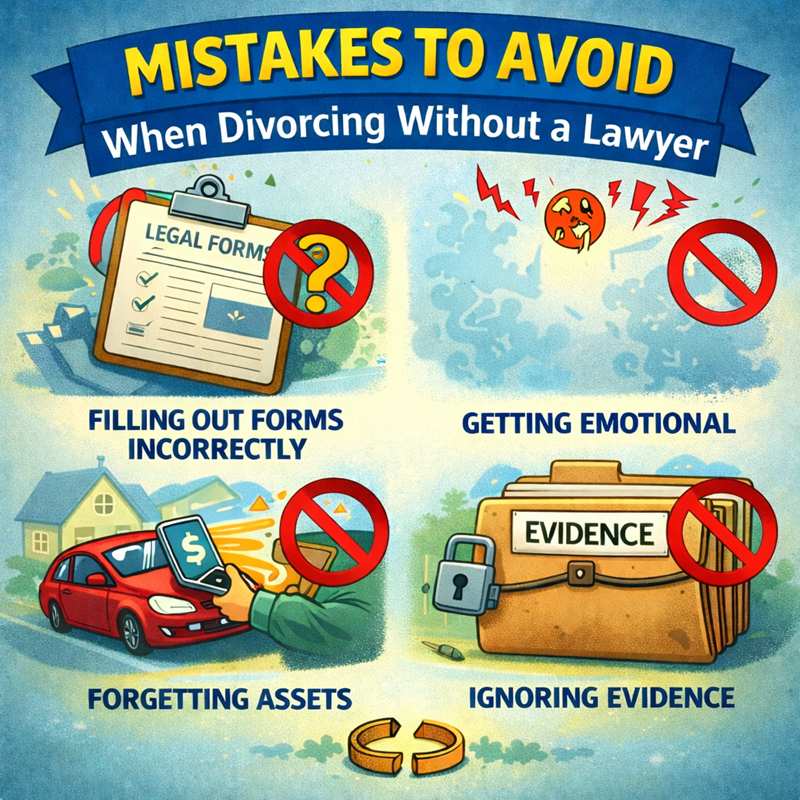
Mistake #1: Assuming “Uncontested” Means “Risk-Free”
One of the most common and costly misconceptions in Ontario divorces is the belief that uncontested automatically means safe. In reality, an uncontested divorce can still create serious legal and financial problems if it is poorly prepared.
Even uncontested divorces must meet legal standards
In Ontario, the court does not approve divorce documents simply because both parties agree. All filings must comply with the Divorce Act and Ontario family law requirements, including proper disclosure, accurate forms, and legally acceptable terms. Issues like child support, parenting arrangements, and property division must meet statutory standards not personal preferences.
Courts can reject unfair or incomplete filings
The Ontario Superior Court of Justice will not approve settlements that appear one-sided, unclear, or inconsistent with the law particularly where children are involved.
Common red flags include:
- Child support amounts that do not follow the Child Support Guidelines
- Vague or missing parenting terms
- Property divisions that ignore equalization rules
- Lack of financial disclosure or sworn statements
Mistake #2: Skipping Full Financial Disclosure
Disclosure is required even without lawyers
Under Ontario family law principles (including the Family Law Act and the Divorce Act), an agreement reached without proper disclosure is vulnerable from day one. Judges routinely emphasize that a spouse cannot meaningfully agree to terms if they do not understand the full financial picture.
Commonly overlooked assets and income sources
Commonly overlooked or misunderstood items include:
- Pensions and retirement plans (including defined benefit and defined contribution pensions)
- Employment benefits such as stock options, RSUs, or deferred compensation
- Bonuses and commissions, even if they are irregular or not yet paid
- Business interests, side income, or self-employment revenue
- Insurance policies, RRSPs, TFSAs, and investment accounts
- Debts, including lines of credit, tax liabilities, and personal loans
Consequences of incomplete or inaccurate disclosure
The consequences of poor disclosure can be serious and long-lasting. Ontario courts have the power to:
- Set aside or reopen agreements years after they are signed
- Order retroactive payments for support that should have been paid
- Penalize the non-disclosing spouse with cost awards or adverse findings
- Invalidate waivers of spousal or property rights
Mistake #3: Giving Up Spousal Support without Understanding Entitlement
Spousal support rights don’t disappear in DIY divorces
Spousal support is not automatic, but it is also not optional in the sense that it can be casually ignored. In Ontario, spousal support entitlement depends on factors such as:
- Length of the relationship or marriage
- Income disparity between spouses
- Roles during the relationship (for example, one spouse leaving the workforce)
- Economic disadvantage caused by the relationship or its breakdown
Waivers can be challenged if uninformed or unfair
Many people believe that once a spousal support waiver is signed, it is final. That is not always true. Ontario courts can set aside or limit the effect of a waiver if:
- One spouse did not understand their entitlement
- There was incomplete financial disclosure
- The outcome is clearly unfair or unconscionable
- Circumstances at the time made the waiver unreasonable
Long-term financial impact of improper waivers
The real danger of an uninformed spousal support waiver is not immediate it’s long-term. Spousal support can affect:
- Ability to retrain or re-enter the workforce
- Retirement savings and long-term financial security
- Housing stability and standard of living
- Financial recovery after separation
Once waived, it can be extremely difficult to reinstate support later, even if circumstances worsen.
Mistake #4: Using Informal or Vague Parenting Arrangements
“We’ll figure it out later” almost always causes disputes
What works during the early months of separation often breaks down once real-life pressures set in. New relationships, work schedules, school demands, or relocation issues quickly expose gaps in informal arrangements. Without written clarity, each parent may remember conversations differently or interpret “flexibility” in ways that suit their own needs.
Parenting plans must be detailed and child-focused
Ontario family law requires parenting arrangements to be guided by the best interests of the child, not parental convenience. A proper parenting plan should clearly explain how day-to-day parenting will work, not rely on goodwill alone.
Effective parenting plans are:
- Specific rather than general
- Written rather than verbal
- Child-centred rather than parent-centred
Common missing details that cause problems
Vague parenting agreements often leave out critical details, including:
- Holiday schedules (statutory holidays, school breaks, birthdays)
- Decision-making responsibility for education, health care, and activities
- Exchange times and locations (pick-ups, drop-offs, transportation)
- Communication rules between parents and with the child
- Travel permissions and notice requirements
- Make-up time if visits are missed
Mistake #5: Signing Agreements without Independent Legal Advice (ILA)
Courts expect ILA in many situations
While Ontario law does not require ILA in every case, courts strongly expect it in many situations especially where there is:
- A significant income or asset imbalance
- A spousal support waiver
- Complex property or pension issues
- Parenting arrangements involving children
- One spouse with less financial or legal knowledge
Judges reviewing agreements through the Ontario Superior Court of Justice frequently ask whether both parties received ILA.
ILA strengthens enforceability
One of the main purposes of ILA is to reduce the risk that an agreement will be set aside in the future. When each spouse receives independent legal advice, it helps demonstrate that:
- The agreement was entered into knowingly
- Rights and obligations were explained and understood
- Financial disclosure was reviewed
- The terms were not unconscionable at the time of signing
One-time legal advice vs. full representation
Many people avoid ILA because they assume it means hiring a lawyer to “take over” the divorce. That is not the case. ILA is often limited in scope and can involve:
- A single meeting with a family lawyer
- A review of the drafted agreement
- An explanation of legal rights and risks
- Written confirmation that advice was provided
FAQs
Is divorcing without a lawyer common in Toronto?
Yes, divorcing without a lawyer is increasingly common in Toronto, particularly for couples pursuing uncontested or joint divorces.
Can a judge reject a lawyer-free divorce agreement?
Yes. A judge can reject a lawyer-free divorce agreement if it does not meet legal standards.
Do mediators work with lawyers during the process?
Often, yes. While mediation itself is typically lawyer-free, many mediators encourage or expect parties to obtain Independent Legal Advice (ILA) before signing a final agreement.
What mistakes cause the most future legal disputes?
The most common causes of future disputes include:
- Incomplete or inaccurate financial disclosure
- Vague parenting arrangements
- Improper or uninformed spousal support waivers
- Lack of Independent Legal Advice
- Agreements rushed for speed rather than quality

As an experienced family and divorce mediator in Toronto, I often write blogs to provide insights, tips, and resources on family mediation and divorce in Ontario. Follow my blog to stay informed and empowered during challenging times.