
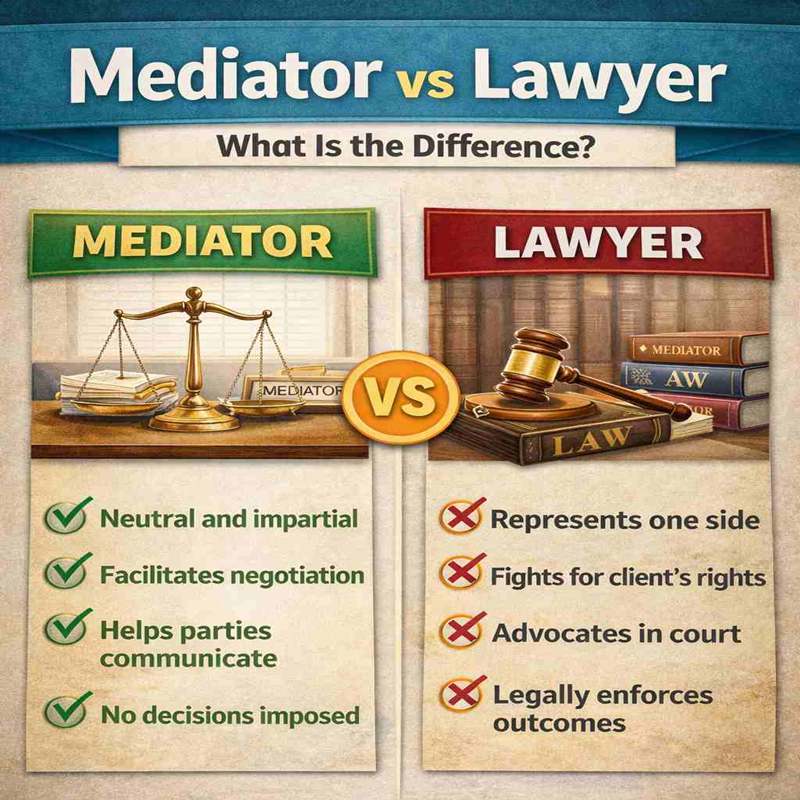
Understanding the Roles: Mediator vs Lawyer
What a Mediator Does
A family mediator’s primary role is to facilitate productive discussions between separating or divorcing spouses. The mediator does not take sides and does not decide outcomes. Instead, they help both parties communicate clearly, identify issues, and work toward mutually acceptable solutions.
In Ontario, mediators typically assist with topics such as:
- parenting schedules and decision-making responsibilities
- child support and spousal support discussions
- division of property and debts
- timelines for selling the matrimonial home
- communication rules and future dispute-resolution steps
A mediator focuses on process, balance, and fairness, not legal strategy.
What a Lawyer Does
A family lawyer’s role is very different. A lawyer’s responsibility is to protect their client’s legal rights and interests. This includes:
- explaining how Ontario family law applies to your situation
- providing legal advice specific to your circumstances
- identifying risks, obligations, and entitlements
- reviewing proposed settlement terms before you sign
- ensuring agreements are enforceable and compliant with the law
Unlike a mediator, a lawyer is not neutral. A lawyer acts only for you, offering advice based on what is best for your legal position, not what is neutral or mutually acceptable.
Before Mediation: When Legal Advice Is Helpful Early
Understanding Legal Rights and Obligations Before Negotiating
Before you start discussing outcomes, it’s important to understand your baseline legal rights and responsibilities. Mediation is about compromise but compromise only makes sense when you know what the law says you are entitled to, and what you are required to do.
Early legal advice can help you understand:
- your legal obligations around child support or spousal support
- how property and debts are treated after separation
- whether certain assets may be excluded or shared
- how parenting decisions are assessed under Ontario’s child-focused framework
Without this knowledge, people may negotiate from a place of fear, misinformation, or assumption often leading to poor decisions.
Clarifying Entitlement to Property, Support, and Parenting Arrangements
One of the most valuable benefits of early legal advice is clarity. A lawyer can explain:
- how property division generally works for married spouses
- whether support may apply, and how duration and amounts are assessed
- how parenting arrangements are evaluated, focusing on the child’s best interests
This does not mean your case is “decided” before mediation. Instead, it gives you a reference point so you know whether a proposed solution is within a reasonable legal range or far outside it.
Identifying Unrealistic Expectations Early
Unrealistic expectations are one of the biggest barriers to successful mediation. Common examples include:
- expecting to pay no child support despite income differences
- assuming equal parenting time is automatic
- believing property division is always a simple 50/50 split
- expecting one party to absorb all debt without legal basis
A brief consultation with a lawyer before mediation can correct these misunderstandings early, preventing emotional escalation and stalled negotiations later.
Knowing What Issues Are Negotiable and Where Legal Limits Exist
Not everything is freely negotiable in mediation. Ontario law sets clear limits on certain issues, especially where children are involved. Early legal advice helps you understand:
- which issues allow flexibility and creative solutions
- where minimum legal standards apply
- what courts are unlikely to approve or enforce
- when a proposed agreement may be vulnerable to being set aside later
Knowing these boundaries makes mediation more efficient. Instead of debating positions that cannot legally stand, both parties can focus on realistic, workable options.
During Mediation: Situations Where a Lawyer Should Be Involved
Complex Property or Debt Division
Property and debt division in Ontario can become complicated quickly, especially when assets were acquired at different stages of the relationship or when liabilities are unevenly shared. Issues often arise with:
- jointly held and separately held assets
- lines of credit, credit cards, and joint loans
- responsibility for post-separation expenses
- disagreements over who pays ongoing “carrying costs”
A lawyer can help clarify how these items are typically treated under Ontario family law and flag risks that may not be obvious during mediation discussions.
Business Ownership, Pensions, or Investments
When one or both spouses own a business, hold pensions, or have investments, mediation discussions often require legal input. These assets may involve:
- valuation issues
- tax consequences
- future income streams
- restrictions on transfer or division
A lawyer can help interpret how these assets are addressed legally and whether outside professionals such as valuators or actuaries should be involved before final decisions are made.
Disputes About Child Support or Spousal Support Amounts
Support discussions are among the most sensitive parts of mediation. Disagreements may arise over:
- income determination
- fluctuating or self-employment income
- special or extraordinary expenses
- duration and review clauses for spousal support
Legal advice during mediation helps ensure support discussions remain aligned with Ontario guidelines and case law, reducing the risk of agreements that are later challenged or rejected.
Unequal Bargaining Power or Communication Challenges
Mediation assumes that both parties can participate freely and fairly. When one party:
- dominates conversations
- controls financial information
- has significantly more legal or financial knowledge
- intimidates or pressures the other
legal support becomes especially important. A lawyer can help level the playing field by advising a client between sessions or, in some cases, attending mediation to ensure informed and voluntary decision-making.
Concerns About Full Financial Disclosure
Mediation relies on honest and complete financial disclosure. Red flags that may justify involving a lawyer include:
- missing or incomplete financial documents
- unexplained income discrepancies
- resistance to providing statements or records
- concerns about hidden assets or debts
A lawyer can advise on what disclosure is required, how to request it properly, and when mediation should pause until full information is available.
After Mediation: Why Independent Legal Advice (ILA) Matters
Reviewing the Mediated Agreement for Legal Compliance
A mediator may help draft a memorandum of understanding or a mediated agreement, but this document still needs to comply with Ontario family law. A lawyer providing ILA will review the agreement to ensure:
- required legal elements are included
- statutory obligations are properly addressed
- the terms align with current Ontario law
- the agreement can be properly converted into a binding contract or court order
Without this review, even well-intentioned agreements can fail when tested legally.
Ensuring the Agreement Is Fair and Enforceable
Courts in Ontario may set aside agreements that are significantly unfair or that fail to meet legal standards. During ILA, a lawyer assesses whether:
- financial disclosure was complete and accurate
- support arrangements meet legal expectations
- one party was pressured or misled
- the agreement reflects informed and voluntary consent
ILA does not require that an agreement be “perfect,” but it helps ensure it falls within a reasonable and defensible legal range.
Identifying Missing Clauses or Unclear Language
One of the most common problems with mediated agreements is vague or incomplete wording. Lawyers regularly identify issues such as:
- unclear payment timelines or methods
- missing review or adjustment clauses
- no enforcement or dispute-resolution provisions
- ambiguous parenting or communication terms
Small drafting gaps can create major problems later. ILA helps refine language so the agreement is clear, practical, and less open to interpretation.

As an experienced family and divorce mediator in Toronto, I often write blogs to provide insights, tips, and resources on family mediation and divorce in Ontario. Follow my blog to stay informed and empowered during challenging times.