
What Is a Mediated Agreement in Ontario?
A mediated agreement in Ontario is a written agreement reached by separating or divorcing parties with the help of a neutral third party a family mediator. The mediator does not make decisions or take sides, but instead helps both parties communicate, identify issues, and negotiate mutually acceptable solutions.
Mediated agreements in Ontario often deal with some or all of the following:
- Parenting arrangements, including parenting time, decision-making responsibility, and parenting schedules
- Child support, based on the Child Support Guidelines
- Spousal support, including entitlement, amount, and duration
- Property division, such as the matrimonial home, debts, pensions, and equalization of net family property
The Court’s Authority to Set Aside Agreements
Although Ontario courts strongly encourage families to resolve disputes through mediation and negotiated settlements, they do not simply rubber-stamp every agreement placed before them. Courts retain ongoing oversight because family law affects fundamental rights, long-term financial security, and most importantly the wellbeing of children.
Importantly, judicial review of a mediated agreement focuses on the process and legality of how the agreement was reached, not on whether one party later feels unhappy with the outcome. Ontario courts consistently distinguish between:
- Regret or second thoughts, which are not enough to set aside an agreement, and
- Serious flaws, such as lack of disclosure, coercion, or misunderstanding of legal rights
At the same time, courts are mindful of the need for finality. Family law disputes must eventually come to an end so parties can move forward with stability and certainty. If agreements were easily undone, mediation would lose its value and families would be pushed back into costly and adversarial court proceedings.
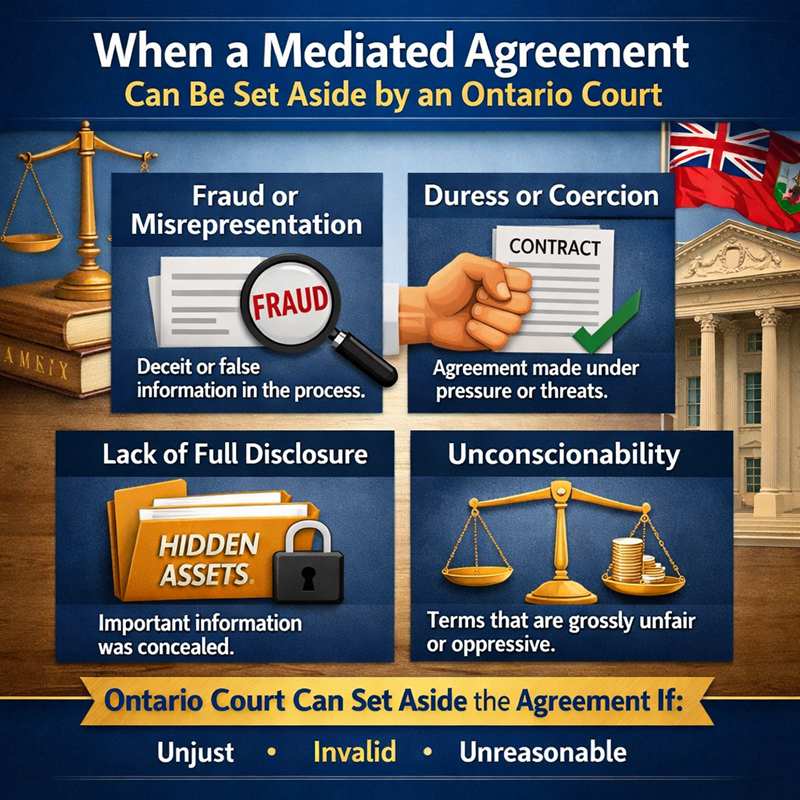
Unconscionability or Extreme Unfairness
An agreement may be considered unconscionable when it results in a clearly one-sided outcome that cannot be reasonably explained by the circumstances at the time. For example, if one spouse walks away with the vast majority of family assets while the other assumes most of the debt, the court may question how that result was reached and whether it reflects a genuine, informed bargain.
Ontario courts also examine whether there was a significant imbalance in bargaining power between the parties. This can arise in many ways, including differences in:
- financial knowledge or access to information
- education or language proficiency
- emotional dependency or fear of conflict
- control over finances or household decisions
If one party was clearly dominant in the negotiation process and the other was unable to advocate for their own interests effectively, the court may find that the agreement was not truly negotiated on equal footing.
Failure to Consider the Best Interests of the Child
Ontario law makes it clear that children’s rights cannot be negotiated away. Parenting terms such as parenting time, decision-making responsibility, and schedules must support a child’s physical, emotional, and psychological wellbeing. If a mediated agreement prioritizes parental convenience, conflict avoidance, or financial trade-offs over a child’s needs, the court may step in and override those terms.
Child support is an area where courts are particularly firm. Support belongs to the child, not the parent receiving it. As a result:
- Parents cannot improperly waive child support
- Agreements that set support far below the Child Support Guidelines without a valid reason are vulnerable to being set aside
- Informal “trade-offs” (such as reduced support in exchange for more parenting time or property concessions) are unlikely to be upheld
Even when both parents consent to these arrangements, the court may find them unenforceable if they do not adequately provide for the child.
Misrepresentation or Fraud
Misrepresentation can occur when one party makes false or misleading statements about matters that are central to the agreement. In family law, this often involves:
- inaccurate claims about income or employment
- misleading statements about the value or ownership of assets
- false assurances about future intentions, such as plans to refinance, sell property, or pay support
Fraud goes a step further and involves knowing deception. This may include deliberately understating income, hiding bank accounts, failing to disclose investments, or transferring assets to third parties to keep them out of reach during negotiations. Even in mediation, parties are legally required to be honest and forthcoming.
FAQs
Can a mediated agreement be overturned years later?
Yes, but only in limited circumstances. Ontario courts can set aside a mediated agreement years after it was signed if there is strong evidence of serious legal flaws, such as fraud, significant non-disclosure, unconscionability, or failure to protect a child’s best interests.
Does mediation protect an agreement from court review?
No. Mediation does not shield an agreement from judicial oversight.
Can child support terms be changed even if agreed?
Yes. Child support is always subject to review because it is considered the right of the child, not the parents.

As an experienced family and divorce mediator in Toronto, I often write blogs to provide insights, tips, and resources on family mediation and divorce in Ontario. Follow my blog to stay informed and empowered during challenging times.